Crescent Head Stories:
Local History and Hidden Places
A white stone in the scrub
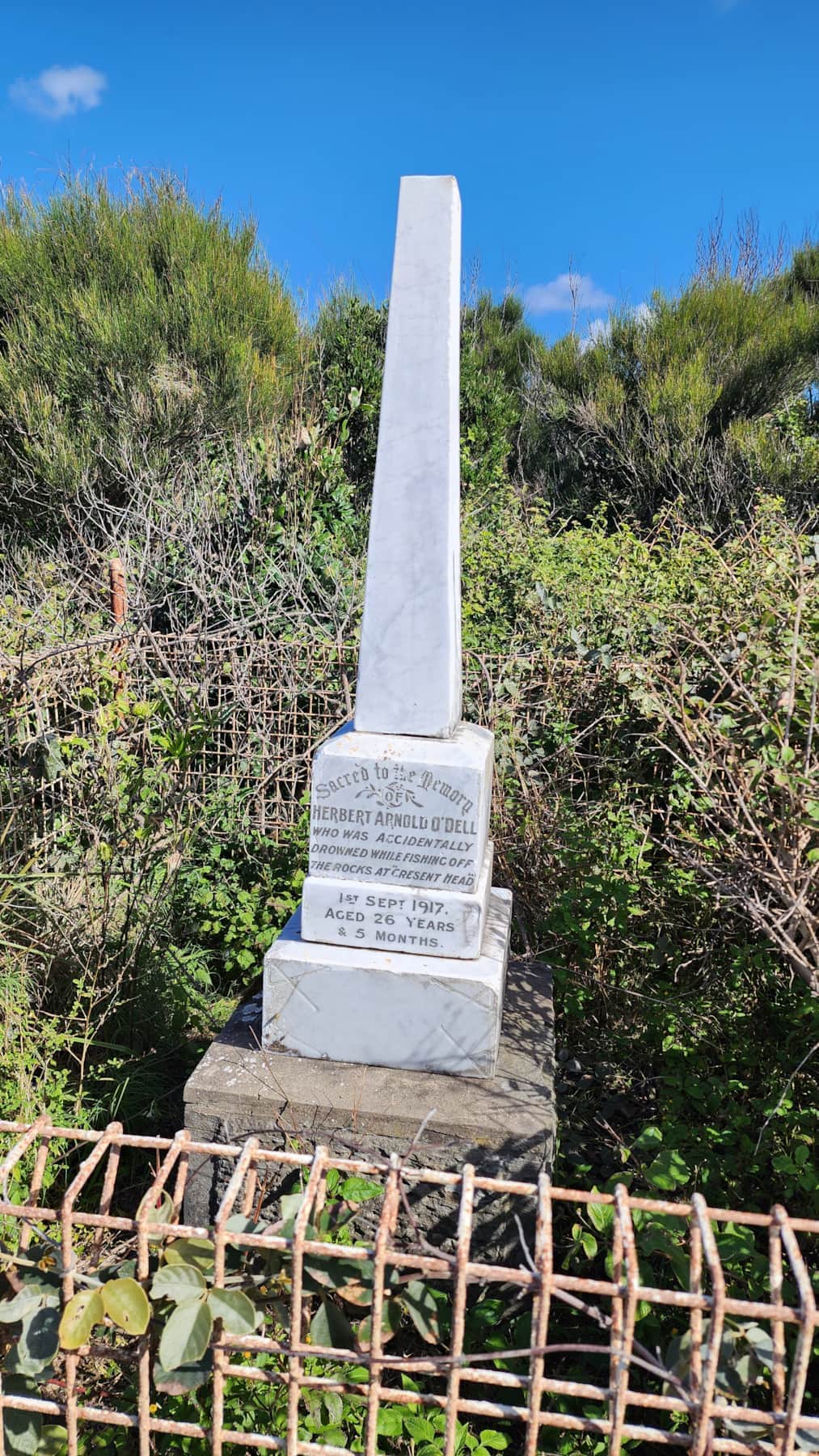
On the track down to Back Beach, a white marble obelisk stands in the coastal scrub. It sits behind a low iron fence, rusted now and tangled with vines. Most walkers pass it on the way to the sand. If you stop and read it, you find one of Crescent Head's oldest stories.
The memorial has been there for more than a century. It marks the death of a young man who went fishing off the rocks and never came home.
Herbert Arnold O'Dell
The inscription reads:
Sacred to the Memory of Herbert Arnold O'Dell, who was accidentally drowned while fishing off the rocks at "Cresent Head". 1st Sept. 1917. Aged 26 years & 5 months.
Those few lines tell us a lot. Herbert was born in the autumn of 1891. He died on the first day of spring 1917, a young man with most of his life ahead of him. The stonemason spelt Crescent as "Cresent", and the name sits in quotation marks, as if the place was still new enough to need them.
A marble obelisk was a costly thing to make, cart and set up in 1917. Someone who loved him paid for it and brought it out to this lonely stretch of coast. They chose to put it here, close to the rocks where he was lost, rather than in a town cemetery.
We don't yet know who Herbert's family were, where he lived, or whether his body was ever recovered. If you know more, we would love to hear from you.
Crescent Head in 1917
Crescent Head looked very different when Herbert died. It had only been declared a village in 1894, and it was a quiet, remote place on Dunghutti Country. People came out from Kempsey and the Macleay farms to camp, fish and get away from things. The busy holiday town we know today was still decades away.
The headlands were fishing spots then, as they are now. Locals climbed down to the rocks for bream, tailor and drummer, with the swell breaking just below. Rock fishing has always been dangerous on this coast. A single big set can sweep someone off a ledge without warning.
Herbert drowned in the fourth year of the First World War. Many young men from the Macleay were away fighting in France and Belgium. For a small community already losing sons overseas, losing another young man at home to the sea would have been a heavy blow.
The Fisherman's Track today
The path down to Back Beach (the northern end of Goolawah Beach) has long been known as the Fisherman's Track. The name fits Herbert's story: for more than a century, people have walked this way to fish off the rocks.
In 2025 Kempsey Shire Council and NSW National Parks and Wildlife Service upgraded and realigned the track. It now runs about 636 metres from the water tower on Skyline Crescent down to Back Beach, with a gentler slope, resting benches and new wayfinding and interpretive signs. Materials were brought in by small machinery, hand tools and helicopter to protect the headland. The round trip takes about 30 minutes.
The new track is the first part of the Five Headlands Coastal Experience. This joint project will link five headlands across four national parks, from South West Rocks to Point Plomer, with walking trails and kayak routes.
Pause on your way down
Next time you walk to Back Beach, look out for the white obelisk beside the track. Take a moment to read Herbert's name. Please leave the memorial and its fence as you find them.
His story is also a reminder for anyone fishing here today. The rocks around Crescent Head can still be deadly. Check the swell before you go, wear a lifejacket, never fish alone, and never turn your back on the sea.
Do you know more about Herbert Arnold O'Dell or his family? We would love to add to his story. Please get in touch.
Sources
- Five Headlands Coastal Experience: Crescent Head construction phases, Kempsey Shire Council
- New walking trail just the start as project links five headlands on the MNC, The Mid North Coaster, 11 June 2025
- Crescent Head, New South Wales, Wikipedia